Aviation Doesn’t Have a Data Problem.
It Has a Structure Problem.
Transforming Technical Manual Chaos into Structured Operational Intelligence.
The Operational Reality
Every airline operates on the same foundation: AMM, FIM, MEL, IPC, Engineering Orders, and Company procedures. Thousands of pages. Multiple revisions. Cross-referenced endlessly.
Yet when a live event hits the Maintenance Control Center, those documents behave like static PDFs — not operational intelligence.And that’s the gap.
In a live troubleshooting event, maintenance control must:
- Identify the correct ATA path
- Navigate FIM decision trees
- Validate corrective action in AMM
- Cross-check MEL dispatch conditions
- Confirm configuration applicability
- Align with current aircraft modification status
THE RESULT
- • Increased decision latency
- • Escalations between shifts
- • Interpretation inconsistencies
- • Unnecessary delay exposure
RAG Processing Pipeline
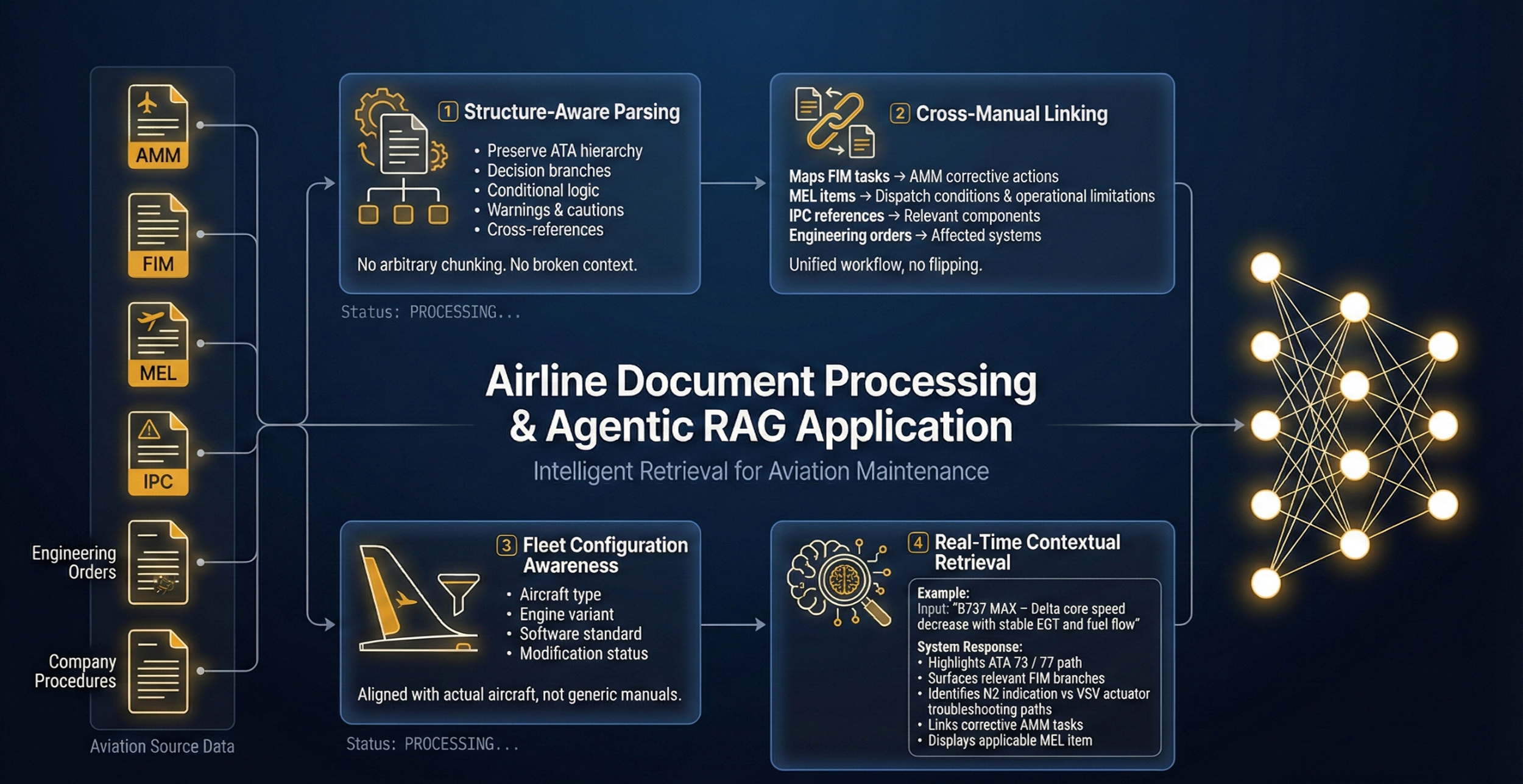
From unstructured PDFs to operational intelligence: The data transformation flow.
From Document Search to
Operational Intelligence
We designed a structured technical intelligence framework that transforms static manuals into a contextual decision-support layer.
Structure-Aware Parsing
Manuals are processed to preserve ATA hierarchy, decision branches, conditional logic, warnings, and cross-references.
Cross-Manual Linking
The system maps FIM tasks to AMM actions, MEL items to dispatch conditions, and IPC references to components.
Fleet Configuration Awareness
Retrieval is filtered by aircraft type, engine variant, software standard, and modification status.
Real-Time Retrieval Example
Measurable Operational Impact
In pilot environments, structured manual intelligence drastically reduced troubleshooting times and error rates.
Financial Implication
The Future of Technical Operations
"Aviation is entering a phase where AI will not replace engineers — it will amplify them."
Standardized Logic
Troubleshooting that follows a consistent, proven path every time.
Cognitive Load
Reduced mental strain on maintenance controllers during high-pressure events.
Predictive Foundation
Structured data sets the stage for true predictive maintenance workflows.
The competitive advantage will not come from owning more documents.
It will come from structuring them.